
Full Fibre broadband, also known as FTTP (Fibre to the Premises) or FTTH (Fibre to the Home), is the fastest and most reliable type of broadband currently available in the UK.
Unlike older broadband technologies that rely partly on copper telephone cables, Full Fibre uses fibre-optic cables all the way from the broadband network directly into your home.
This allows for significantly faster speeds, lower latency, greater reliability, and a connection that isn’t affected by the distance between your property and the nearest street cabinet.
Today, Full Fibre networks are being expanded across the UK by Openreach, Virgin Media, CityFibre and dozens of alternative network operators, giving millions of homes access to gigabit-capable broadband.
Whether you’re upgrading your broadband or simply wondering if Full Fibre is available where you live, this guide explains everything you need to know.
Fibre vs Full Fibre: What’s the Difference?
One of the biggest sources of confusion is that many broadband providers have marketed FTTC (Fibre to the Cabinet) services as “Fibre Broadband” for years, even though the final connection into your home still relies on traditional copper telephone cables.
Full Fibre, also known as FTTP (Fibre to the Premises), removes copper from the equation entirely by running fibre-optic cable directly into your property.
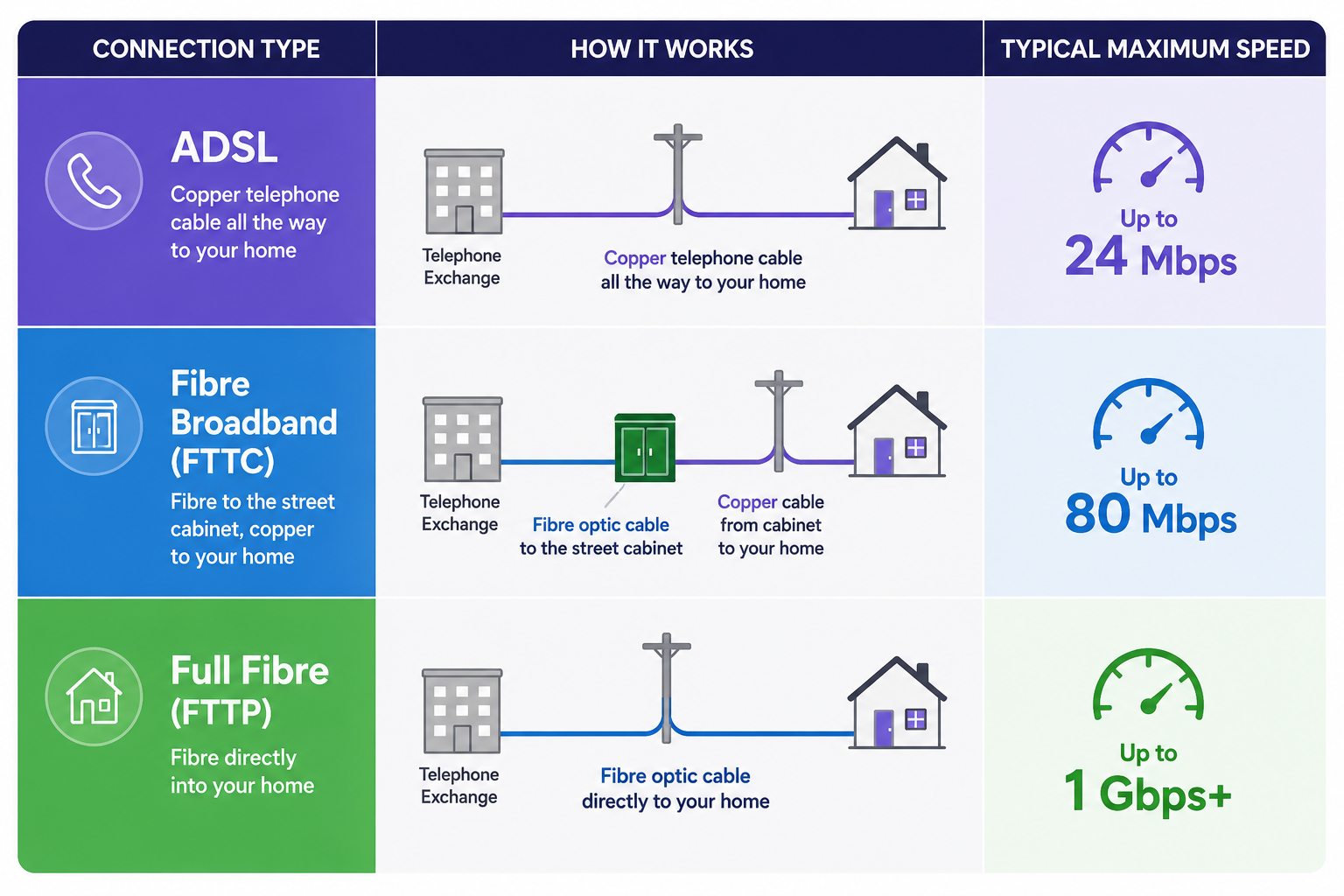
With FTTC, broadband speeds can gradually decrease the further your property is from the street cabinet because the final part of the connection still travels over copper wiring.
Full Fibre eliminates this bottleneck, delivering consistently faster speeds, lower latency and a more reliable connection regardless of how far your home is from the cabinet.
How Does Full Fibre Broadband Work?
Instead of transmitting data using electrical signals over copper telephone lines, Full Fibre carries information using pulses of light travelling through fibre-optic cables.
A typical Full Fibre connection follows this path:
Broadband Exchange → Fibre Network → Fibre Optic Cable → Optical Network Terminal (ONT) → Wi-Fi Router → Your Devices
When Full Fibre is installed, an engineer fits a small Optical Network Terminal (ONT) inside your property. This converts the optical signal into an Ethernet connection that plugs directly into your broadband router. From there, your phones, laptops, TVs, games consoles and smart home devices connect exactly as they would with any other broadband service.
Check Full Fibre Availability
Find out if Full Fibre broadband is available at your address in seconds. Enter your postcode to compare available broadband providers, view the fastest speeds available, and explore the latest Full Fibre packages in your area.
Why Is Full Fibre Faster?
The biggest advantage of Full Fibre is that it removes the copper bottleneck found in older broadband technologies.
Because fibre-optic cables transmit data using light rather than electrical signals, they can carry significantly more information over much longer distances with minimal signal loss. This results in faster download speeds, much higher upload speeds, lower latency and a more stable connection throughout the day.
Many Full Fibre providers now offer broadband packages ranging from 100 Mbps to over 2 Gbps, while some alternative networks already provide symmetrical services where upload speeds match download speeds. Even if you don’t need gigabit broadband today, Full Fibre provides a more reliable connection that’s built to support the increasing demands of modern households.
Who Builds Full Fibre Networks in the UK?
One of the biggest misconceptions about broadband in the UK is that broadband providers build their own fibre networks.
In reality, network operators build and maintain the physical fibre infrastructure, while internet service providers (ISPs) sell broadband services that use those networks.
Some of the UK’s largest Full Fibre network operators include:
- Openreach
- Virgin Media
- CityFibre
- Hyperoptic
- Community Fibre
- Gigaclear
- Netomnia
- nexfibre
Each company has its own rollout plans, meaning the Full Fibre infrastructure available can vary significantly from one postcode to another. In some parts of the UK, multiple fibre networks overlap, giving homeowners a choice of providers, while other areas may currently be served by just a single network.
Which Broadband Providers Offer Full Fibre?
Once a Full Fibre network has been built in your area, multiple broadband providers may be able to offer services over that infrastructure.
For example, the Openreach network is used by providers including BT, EE, Sky, Plusnet, TalkTalk, Vodafone and Zen Internet. CityFibre also wholesales access to several providers, including Vodafone, TalkTalk, Zen Internet and, in selected areas, Sky.
Other providers, including Virgin Media, Hyperoptic and Community Fibre, primarily operate on their own networks and sell broadband directly to consumers.
Because of this, two neighbouring homes can have completely different broadband providers available depending on which fibre networks serve each property. It’s also becoming increasingly common for homes to have access to more than one Full Fibre network, giving consumers greater choice than ever before.
Is Full Fibre Available at My Address?
Full Fibre coverage has expanded rapidly across the UK over the past few years, but availability still depends on your exact location.
Some homes can choose between multiple Full Fibre networks, while others may currently only have access to Fibre Broadband (FTTC) or older ADSL connections. Because different network operators build infrastructure independently, availability can vary even between neighbouring streets.
The easiest way to find out what’s available is by checking your postcode. Our Full Fibre Checker shows:
- Whether Full Fibre is available at your address.
- Which broadband providers are available.
- The maximum speeds you can receive.
- The broadband packages you can order.
- Why Isn’t Full Fibre Available Everywhere?
Rolling out Full Fibre infrastructure is one of the largest telecommunications projects ever undertaken in the UK.
Unlike mobile networks, fibre-optic cables must be physically installed underground or on telegraph poles before broadband providers can offer service. This requires significant investment, engineering work and planning, so rollout takes time.
Network operators decide where to build next based on factors such as population density, existing infrastructure, construction costs and local demand. As a result, some towns already have several competing Full Fibre networks, while more rural areas may still be waiting for their first fibre deployment.
The good news is that rollout continues at a rapid pace, with millions of additional UK homes gaining access to Full Fibre every year.
Is Full Fibre Worth It?
For many households, the answer is yes.
The price difference between Fibre Broadband (FTTC) and Full Fibre has fallen significantly in recent years, making Full Fibre one of the best broadband upgrades available.
Households with multiple people online at the same time, remote workers, gamers and anyone who regularly uploads large files or uses cloud storage will benefit from faster speeds and a more stable connection. Even if you don’t need gigabit broadband today, Full Fibre offers better long-term reliability and is designed to support the growing number of connected devices found in modern homes.
How Is Full Fibre Installed?
If your property doesn’t already have Full Fibre, your broadband provider will arrange for an engineer to complete the installation.
The installation usually involves four simple steps:
- A fibre-optic cable is run from the nearest network connection to your property.
- An Optical Network Terminal (ONT) is installed inside your home.
- Your broadband router is connected to the ONT.
- The engineer tests the connection to ensure everything is working correctly.
Most installations are completed within a few hours, although the exact process depends on the network operator and your property’s existing infrastructure.
Check Full Fibre Availability
Full Fibre broadband is transforming internet connectivity across the UK, offering faster speeds, greater reliability and a future-proof alternative to older copper-based broadband technologies.
As more network operators continue expanding their infrastructure, millions of additional homes are gaining access to gigabit-capable broadband every year. However, availability still depends on your exact address, and the providers you can choose from may differ from those available just a few streets away.
The quickest way to find out what’s available is to check your postcode.